
The Devil Wears Prada 2 is not worthwhile
Runway and run away.

Runway (2026) is terrible. I will not argue the point with you, because you have ears. It has been compared to original songs made for Rupaul’s Drag Race (2009-present) and I think that is an earned comparison. Doechii and Lady Gaga are not necessarily better than this, but I am and you should be too. The song a corporate facsimile of dance music designed to pander to the audience that cries out for a sequel to The Devil Wears Prada (2006).
So, in that way, it’s perfect!
Sequels are hard. Legacy sequels are harder. When you have a film that is beloved and clearly not made for serialisation, you’re left with very few options. But one thing I beg all screenwriters to do is ask themselves…am I writing a film, or a spinoff to And Just Like That… (2021-2025)?
The original The Devil Wears Prada holds such a weird place in the careers of basically all involved. It acts as the turning point for Meryl Streep, Anne Hathaway, and Emily Blunt as actors and stars, gave director David Frankel enough clout for nearly a decade of consistent filmmaking (only stumbling with the truly awful Collateral Beauty in 2016), and boosted the profile of screenwriter Aline Brosh McKenna. Everyone walked away from the experience richer in money and clout, all for a film described at the time as “bizarre” (New York, 2006) and “full of predictable cliches” (The Guardian, 2006).
That isn’t to say it was poorly reviewed (hence the Oscar nom for Streep), but more that everyone could tell this was a decidedly commercial venture. It was good, but decidedly overshadowed by a year filled with truly great films. Worthy of critique for a thin script and the unbelievable choice to label slender, doe eyed Hathaway as somehow dumpier and less obviously fashionable than those surrounding her. Something that not even misshapen costuming sold to audiences. It’s a film heavy on quips, which has made it singularly memorable as clipping has taken over the collective consciousness. A film legacy built by social media. But mostly, it is a vehicle for Streep to be a presence on screen. The sheer weight of her glance is what drives the film and allows the audience to be drawn into a fashionable fairytale.
But…the sequel.
I want to start off with the positives. Blunt is fantastic - she steals the show as Emily all over again. Stanley Tucci also a stand out, especially given the dialogue he is working with. And even with that dig, it must be noted that McKenna as a writer is still able to find small moments of humanity and fun within the confines of a very high strung environment. I also appreciate her pro-human take on the current state of journalism. The script is often lumbering and desperate, but never dull and often more dignified than it has any right to be.
The Devil Wears Prada 2 also looks fine. A lot of critiques of contemporary filmmaking make the argument that they look worse than earlier ones, but Frankel is basically the same competent filmmaker he was in 2006. Scenes are lit well and with a clear eye for both where the light should be and how to manipulate that to have everyone look correct. Is it magic on screen? No, but it looks fine.
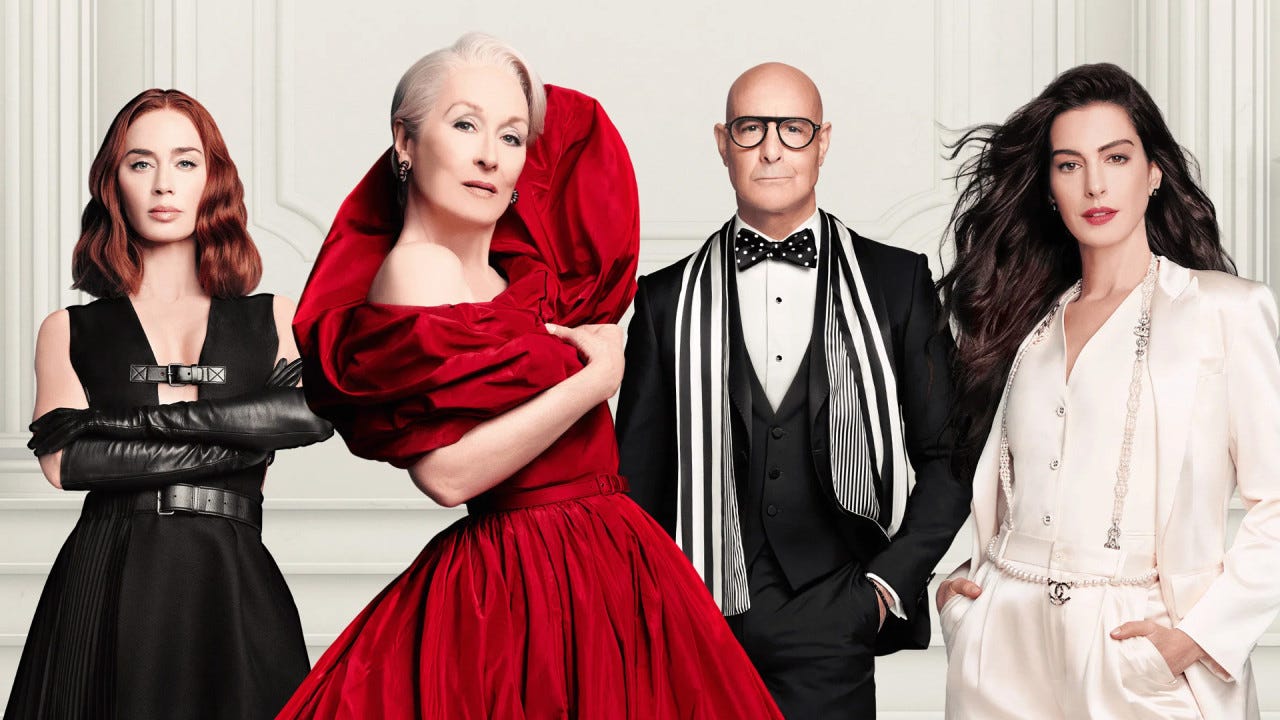
However, the fashion is awful. Consistently ugly and mismatched in a way that you’re not expecting. Steep and Hathaway both wear more than one sequin covered monstrosity that films terribly and looks so cheap. There was one outfit that made me think of a sparkly child’s onsie. These terrible outfits only exist on Streep and Hathaway. I appreciate that I am not necessarily the most fashionable man in the world, but it really does feel like the goal was to have as much sparkle on screen for the leads as possible, which was the wrong choice.
Granted, I happen to like the tassel jacket, so there’s no accounting for taste.
I’ve seen a lot of positive reviews that I don’t agree with. Much of the film’s goodwill is earned in the subtleties concerning Miranda that are predicated on knowing the original. In the hands of Streep, it is golden. Her heightened insecurities butting against Andy’s reckless optimism. The quiet resignation of Nigel and the earned push and pull between the two. In many ways, because the original film did a lot of the heavy lifting, these moments are not forced to signpost themselves. It is assumed you can recognise unspoken communication between the characters. The film relies on her too much and definitely could have stood to not soften her as much as they did, but outside of a few moments in the final act, they let Streep do the heavy lifting. That confidence in the audience is not given to anything else. McKenna and Frankel assume you are an idiot.
Milan is where the film falls apart. It’s where the dialogue goes from hokey to amateurish. Blunt gets a full on villain monologue that is fun but tonally incongruent with both the first film and most of the new one. The Runway runway show in Milan is essentially a short musical sequence for Lady Gaga in order to justify her cameo. The sequence is shot terribly and is completely unnecessary. We get too much of Miranda, both her humanity and her very presence. The entire final act of the film is mind boggling in execution.
Amari, Miranda’s current first assistant, is holds the prize for the piece of dialogue I hate the most. This is not Simone Ashley’s fault, but an issue of direction and editing. The line “Who gives away Chanel?” is a throwaway joke that would absolutely make it into the shooting script. A fine little button on a joke. Justifiable at that stage. It’s also completely unnecessary and should have absolutely been cut. A smart director would have gotten a take without it once Ashley managed to make the joke of the scene hit with her initial reaction, and a competent overall creative team would have allowed the editor to cut away early. Unfortunately, it is only in Streep’s performance that the film trusts the audience to understand without being guided.
Part of me wants to rewatch the film and time how much of the dialogue is spent filling in the preceding twenty years. We spend a lot of time resetting Runway as a magazine, explaining the stakes for Miranda, touching on Andy’s single status, her friendship with Lisa, Emily’s divorce, Nigel and his…well, mostly that he’s still there. It is cumbersome and unnecessary. Emily’s asshole ex husband offers no thematic or even narrative use - he is just there to explain that the character lived between films.
There’s a choice made to recenter the Andy and Miranda relationship that I found clumsy. Andy as a middle aged woman still acts like a fresh college graduate with endless hope and no life experience. Peppy to an unreasonable and unlikeable point. There’s lot of “but journalism is important” speeches that make her unbearably precocious - not a word anybody should use to describe a woman pushing well past forty. Her Australian boyfriend is a particularly weird addition - a milquetoast sketch of a man who she only seems interested in insulting. There’s a moment where he’s comforting her and she straight up says her work is more important than his to no push back. The film endorses this weirdly cruel jab, because it wants to be about journalism and AI and integrity. He has none, and his job is bad because he’s making buildings ugly. There’s nothing else to him, and he takes her unearned meanness with bland stoicism, because he is not a character. His traits are being Australian and being attracted to Anne Hathaway - that’s could be me.
There’s an argument to be made that while Andy is the protagonist of the original film, the “franchise” could and should orbit primarily around Miranda. This sequel does not do that, and instead hands the film from Streep to Hathaway. A bad decision, because while Hathaway is an excellent actress, she’s no Meryl Streep. The film clearly agrees, given how much dialogue they throw at her to explain basic emotions she should be able to communicate through her performance. Her acting is so weirdly calibrated and overly chipper for most of it that I just…glazed over. Andy in the original film is sharp and mature despite her insecurity, but her sequel self is a wide eyed mess of stuttering and giant smiles. This is an adorkable take on Andy and everyone should be ashamed at that. It’s decidedly less human than the first film.
It’s been a weird few years for Hathaway. For all actresses of a certain age, really. Her cohort of middle aged movie stars seem to be working more than ever. It feels like vehicles for the stars of yesteryear are more common than anything else. She is on film two of five for this year, while Streep has two films currently out (three if you count the cameo in Project Hail Mary) and is a regular special guest on Only Murders in the Building, which will be back on streaming later this year. There’s a lot of content, but absolutely no quality control.
For years, the argument was that there was nothing out there for women past forty. That really hasn’t been the case for at least half a decade now. As the industry cannibalises itself, star power is hard to come by (because that involves an investment studios are hesitant to commit to) and those that have it get stuff made. But everything is so much worse now. Handing Hollywood over to the actors and the business men has meant a lot of creatives who should be rising to make good art are just not getting the support they deserve.
Film, or at least the Hollywood version of the medium, requires a lot of money and effort. These are products and art at once. But they do require somebody on high with a vision behind them and a belief that the output can be met by the audience. It requires a certain confidence in people to get and enjoy the movie without spoon feeding it to them. But it is clear that a lot of people are under the assumption cinema is dead, dying, and needs an injection of cash that only pandering films can give them. But that is exactly what generative AI offers people. The opportunity to see exactly what they want, without gatekeepers and artists using their status to direct taste. Which is awful.
People don’t know what they want until they have it. That’s the whole point of the first film and that goddamn cerulean monologue that spent a decade going viral. The masses are lazy and uncreative. They make Fruit Love Island AI videos and think that’s the height of entertainment. If you solely cater to what they think they want, we’ll never escape the cycle of remakes, reboot, sequels, and knock offs. Something The Devil Wears Prada 2 tells us, while playing into the exact problem. Instead of trying something knew, we get a film that forces everyone into their same roles for a second time, and plays it as broadly as possible.
This being about Andy and Miranda again is a decision that had to be made for a nostalgic audience, and that kneecaps the script. McKenna is not an untalented writer, but this is a bad script. One that feels decidedly plagued by studio notes, as you’d expect for a sequel designed to sell clothes. There’s a host of new assistants that pop up and are a presence throughout. They are sketched out enough to warrant being characters. It might be compelling to see how they navigate a Runway that is entirely different to the original film. Why are they not the focus?
These new characters feel like they’re being introduced for future instalments. The Devil Wears Prada 2 (2026) is a film written like the season finale of a television show hesitant about it’s ability to keep the returning cast. It’s twelve episodes of “prestige” television crammed into two hours of call backs and references to the original film that often feel so lazy. Just like Sex and the City (2008).
It’s a clumsy film. Awkward and bad enough that it will undoubtably be looked at with disdain if audiences ever reestablish their good taste. But also, it’s candy, so who can blame them for wanting it?
Me. Don’t go.
You’re better than this.